Do now
- Set a timer.
- Attempt the problem. Stop at the attempt line. Do not scroll.
- Then read.
Time box
40 minutes.
| Minutes | Do this |
|---|---|
| 0–12 | Attempt. The read that melts, the miss path, and the thing you will not put in the cache. |
| 12–32 | Read. If your cache can return a paste the row would 404, it is wrong. Fix the rule, not the vendor. |
| 32–40 | Say the miss path from memory, including delete. |
Intent
Facing a database melted by reads, leave able to add cache-aside and name the miss path and what must not be cached. The cache is a fix for the primary’s read ceiling. It is not a faster disk, and it is not where expiry becomes “whenever the entry says.”
Problem
Design a pastebin. People paste text and share a link.
The interviewer says: “The app tier is no longer the ceiling. The primary is. Every read still asks it whether the paste is alive.”
Attempt before reading
12 minutes. Do not scroll. You have four app processes behind a balancer, rows on one Postgres, bodies on one NVMe. Peak is about 17,400 reads/s and 350 writes/s.
Write:
- A planning ceiling for point reads on that primary while it is also committing the writes. Compare it to 17,400. If you are not over, do not add a cache; say what would have to change before you would.
- The get path on a miss and on a hit. Where the body comes from. The body is not automatically the cached thing.
- What you refuse to cache, by name: at least the delete-token hash, and the “this is readable” bit without
expires_at. - What a delete must do to the entry, and the race you still have if a read fills the cache after the delete.
Stop. Cache-aside below. The primary stays the source of the row.
Requirements
Contract unchanged. Expired and missing are the same 404. A live row with a missing body is a 500. Delete makes the paste unreadable at the origin when the row commit returns. You are about to bend that last sentence by a race you must name, not by a TTL you hope is short.
New planning ceiling, same status as the 5 ms fsync and the 8,000-read process:
A primary that is group-committing a few hundred writes a second can serve about 15,000 point reads a second before its CPU saturates. Not a benchmark. Peak reads are 17,400. You are over, barely, before you count the sweeper and the replica you do not have yet.
Day 5 told you not to add a cache to feel safe, and to load-test the 17,400 point reads. This day is that test coming back over the line you are willing to promise. If they tell you the primary does 80,000 point reads while writing, you take the cache back off and you do not argue. The box has to follow the ceiling.
The body bytes are not why the primary melts. The primary does not store them. Caching the 10 KB body in this box would be a different break (origin bandwidth, day 15). Today you cache the row you use to decide.
Design
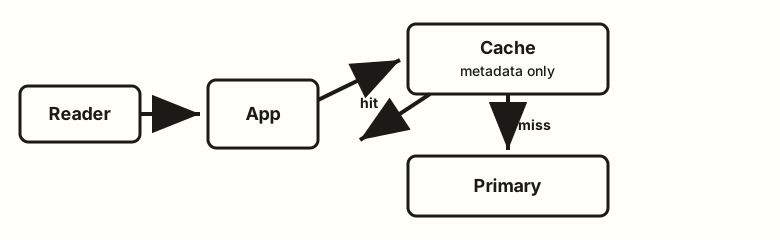
Cache-aside, also called lazy fill. The app talks to the cache. The cache does not talk to Postgres. There is no write-through and no subscriber on the WAL. A subscriber is a second system you have not failed yet.
The cache holds, keyed by paste id:
expires_atsize_bytessyntax, if any- a generation, or simply enough to know the row was live when you read it
It does not hold:
delete_token_hash. Delete is rare and must hit the primary. A cache that stores the hash is a second copy of a verifier you do not need on the read path, and a wider blast radius when the cache is dumped.- The raw delete token. You never stored it at all.
- The body. Up to 1,000,000 bytes a value, 4.5 TB resident. That is not a cache. That is an unacknowledged second disk.
- A bare boolean “readable.” Without
expires_at, a hit cannot be re-checked, and expiry becomes “when the entry happens to die.” - A 404. Random ids from a scanner would fill the cache with negatives. Ids are unguessable, so this is abuse-shaped, not the product. You do not spend RAM on misses. A missing key means “ask the primary,” not “we know it is absent.”
One cache node is enough for the hot metadata. You are not sharding it today. Day 18 is what happens when nodes appear and disappear. Today, one process, a few gigabytes, in front of the primary. If it dies, every read misses and the primary sees the full 17,400, which is the ceiling you just said it cannot hold. That failure belongs on the overlay, not in a silent hope. Name it: cache down means you shed or you melt. Shedding is day 19. Today, say the dependency.
Hit
- App gets the key.
- No entry: miss, below.
- Entry present and
expires_at <= nowon the app clock: treat as 404. Do not serve the body. You may drop the entry. A sweeper being behind is irrelevant, same as day 5. - Entry present and not expired: read the body from the NVMe by id. If the file is missing, 500 and
body_missing. The cache does not get to hide data loss. - Stream
text/plainwithnosniff.
The hit still checks expiry. The TTL on the cache entry is not the paste TTL.
Miss
- Point read on the primary, not on a replica you have not drawn.
- No row, or row expired: 404. Do not fill a negative.
- Live row: read the body from the NVMe. Missing file: 500, do not cache a success.
- Then set the cache entry. TTL 60 seconds, and you will jitter it on day 11. The 60 seconds is a bound on how long a missed invalidation can live, and a bound on memory. It is not how you delete.
- Return the body.
Fill after you know the body exists, so you do not cache a row you just turned into a 500. If you prefer to cache the row even when you then 500, you may, but you must not cache a positive body you did not see. Keep the entry to metadata either way.
Write and delete
Create does not need to warm the cache. The creator has the body. The first reader fills. Warming on create is how you spend cache RAM on pastes nobody reads. Most links are not viral. 450 million live objects will not fit, and you should not try.
Delete, after the row commit on the primary, deletes the cache key before you return 204. Order: commit the row removal, delete the key, unlink the file, then 204. If you 204 before the key is gone, a reader on another app can still hit. You wait for the cache delete. It is one round trip. The user who is deleting is not the one you were protecting with asynchrony.
The race you still have: a miss reads the primary before the delete commits, then SETs the cache after you DEL the key. The paste is readable again until the 60 second TTL, even though the row is gone. Day 11 will not fix this; a stampede lock is not an invalidation protocol. The patch you should be able to say, even if you do not build a framework: write a tombstone (gone, TTL a bit longer than the fill window, say 75 seconds) instead of a bare DEL, and the miss path must not overwrite a tombstone with a resurrected row. A late fill checks “tombstone wins.” That is interview depth. A distributed transaction with the database is not.
Until the tombstone is in the picture, the honest contract is: origin reads can observe a deleted paste for up to one in-flight miss, and then for the TTL if you lose the race. Say it. Do not say “cache-aside is consistent.”
Expiry does not delete the key. The read checks expires_at. A stale entry past expiry is a 404 on the hit path. That is why the timestamp is inside the value.
The two numbers the cache has to state
The hit rate you need, not the one you hope for. The primary must see at most 15,000 point reads at peak. Misses are 17,400 × (1 − h). Solve: h ≥ about 14% just to get under the ceiling. That is the honest minimum, and it is small. Running a primary at its ceiling is not a plan, so say the target with headroom: keep the primary under about half its ceiling, 7,500, and you need h ≥ about 57%. State it in that order: “I need 14% to survive and I want about 57% to sleep.” You still have not claimed what the traffic will give you. You have said what it must give you, which is a number a load test can falsify.
Memory, bounded by the TTL. An entry lives at most 60 seconds after its last fill. The most distinct ids you can hold is reads per second times TTL: 17,400 × 60 ≈ 1.04 million entries, and that is the worst case where every read is a different id. A metadata entry with its key and the cache’s own overhead is on the order of 200 bytes. About 1 million × 200 B is roughly 200 MB. “A few gigabytes” is headroom, not need. Say the arithmetic, because it is also the reason you do not shard the cache today: the TTL, not the 450 million live objects, sets the working set.
What staff sounds like here is the order of claims. First the ceiling you are over, then the minimum hit rate that fixes it, then the memory the TTL implies, then the one failure that makes the cache a dependency. A senior answer opens with “Redis, 90% hit rate” and spends the rest of the interview defending a number nobody measured. A staff answer can survive the interviewer saying “assume the hit rate is 30%”: at 30%, misses are about 12,200, under the ceiling with little room, and you say exactly that.
Diagrams
Miss path
sequenceDiagram
  participant C as Client
  participant A as App
  participant K as Cache
  participant P as Primary
  participant D as NVMe
  C->>A: GET id
  A->>K: get id
  K-->>A: miss
  A->>P: point lookup
  alt no row or expired
    A-->>C: 404
  else live row
    A->>D: read body
    A->>K: set metadata, TTL 60s
    A-->>C: 200 text/plain
  end
There is no arrow from the cache to the primary. If you drew one, you built a different mechanism and you should say so.
Caption it: “Fill after the body is confirmed. No negative fill. No cache-to-primary arrow.” The set arrow comes after the NVMe read on purpose. Move it above the body read and you have cached a success you never saw.
What must not be cached
flowchart TB
  row[Row on primary]
  row --> yes[Cache expires_at size syntax]
  row --> no1[Do not cache token hash]
  row --> no2[Do not cache the body]
  row --> no3[Do not cache a bare readable bit]
  row --> no4[Do not cache 404]
Caption: “One yes, four refusals, each with a reason.” Practice saying the reason with each refusal: the hash widens a breach, the body is a second disk, a bare bit cannot be re-checked, and a 404 is scanner food. A list of refusals without reasons sounds like a rule you memorized.
Failure the user sees, now that the cache is in the path
The cache dies or restarts empty. Hit rate goes to zero. The primary sees the full 17,400 against a 15,000 ceiling, about 16% over. Users see reads slow down, then time out at the tail, and creates slow with them because the same primary commits the writes. Recovery is fast in principle: hot ids refill on their first miss. In practice the refill traffic is the overload. This is the stampede day 11 owns. Today the sentence is: “cache restart is a primary incident, so I page on primary CPU and I shed before I melt.”
The cache is slow, not dead. Worse than dead. A get that hangs holds an app request and a connection. Set a tight budget on the cache call, a few milliseconds, and treat a timeout as a miss. Then say the catch: a slow cache that times out on every call becomes a 0% hit rate, which is the dead-cache case with extra latency on top. The budget turns a hang into a known failure; it does not make the primary bigger.
A delete races a fill. The user deletes, gets 204, shares “it’s gone,” and a stranger opens the link and sees it for up to 60 seconds. That is the race without a tombstone. With the tombstone, it narrows to readers who were already streaming. Say which one you built.
Clocks disagree. The hit path checks expires_at on the app clock. An app clock a few seconds behind serves an expired paste for those seconds. Time sync on the app hosts keeps that to well under a second; say it so the skew is a stated bound, not a surprise.
Trade-offs
Choice. Cache-aside of the metadata row, 60 second TTL, tombstone on delete, body stays on the NVMe, primary is the only fill source.
Alternative. A bigger primary, or a read replica for every GET, or write-through so the cache never misses a create.
What you give up. A dependency. Cache down throws the full read peak back at a primary you said cannot take it. You also give up a strict “delete is instantly invisible” unless the tombstone race is closed, and even then a reader who already passed the check is streaming. You accept a bounded race instead of a two-phase commit between Postgres and the cache.
Why not the alternatives. A bigger primary spends money on a ceiling you will hit again when the read ratio moves, and it does not give you a place to absorb a hot key tomorrow. A replica can serve stale deletes if you read it for this path; that refusal is day 13, and you will not sneak the replica in as “the cache.” Write-through fills entries nobody reads and still needs the delete path. It does not remove the race; it moves it.
Name the refusal inside each alternative. Against the bigger primary: you refuse to buy a ceiling that moves the cliff without giving you anywhere to absorb a hot key. Against a replica for every GET: you refuse to serve deletes stale by replication lag on the path where delete must win, and you refuse to sneak a replica in as “the cache.” Against write-through: you refuse to spend RAM on pastes nobody reads, since most links are never hot, and you notice it does not remove the delete race. Each refusal is about the delete contract or the memory, not taste.
10× break. Peak reads ~174,000. Even a 90% hit rate, which you must not invent today as a silent factor, leaves 174,000 × 0.10 = 17,400 misses. That is the whole peak again, and it is over the 15,000 ceiling. At 10× the cache is necessary and not sufficient; you will need the hit rate stated in the open (day 21) and a plan for the miss storm (day 11). A 60 second TTL at 10× also means a deleted viral paste can be served from a stale entry to a much larger audience. The tombstone matters more as the site gets bigger, not less.
Talking points
Say. “I’m over a planning ceiling of about 15,000 primary point reads a second once writes are in the picture, and peak is 17,400. Cache-aside on the metadata only. Miss reads the primary, then fills. Hit still checks expires_at. I do not cache the body, the token hash, or 404s.”
Say. “Delete commits the row, writes a tombstone the fill path will not overwrite, then unlinks. TTL is how I bound a bug. It is not how I delete. A late fill after a bare DEL can resurrect a paste for the rest of the TTL. I will not call that consistent.”
Hand-waving. “Redis in front, 90% hit rate, so the database sees 1,700.” You smuggled the hit rate. Today you have not earned it. The miss path has to be correct at a 0% hit rate, which is a cold cache and a restart.
Hand-waving. “The cache expires the paste.” The paste expires because of expires_at on the read. The cache entry expires so RAM and mistakes stay bounded.
Hand-waving. “We’ll cache the rendered page.” You do not render. text/plain is the response. A cached HTML page is the bug day 2 refused.
If they ask what you page on. Cache hit ratio collapsing to the floor, primary CPU, and body_missing. A low hit ratio on a quiet day may be fine. A low hit ratio at peak is the primary about to melt. Alert on primary CPU, not on a vanity hit-rate target.
If they ask what hit rate you are assuming. “None. I need about 14% to get the primary under 15,000 and I want about 57% so it sits at half. Those are requirements I’d verify with a load test, not a forecast. If the traffic is uniform over 450 million ids, I don’t get them, and I say the cache doesn’t fix this.”
If they ask how big the cache is. “TTL times read rate bounds it: 17,400 a second for 60 seconds is about a million entries, a couple hundred bytes each, so roughly 200 MB. I’d give it a few GB and not shard it.”
If they ask why not cache the body too, to save the disk read. “The disk wasn’t the break; the primary was. Bodies are up to a megabyte, so a few hot ones evict thousands of rows. Origin bandwidth is a different break with a different answer, the edge.”
If they ask read-your-writes for the creator. The creator does not need to GET. They have the bytes. A reader who is handed the URL a second later will miss, fill, and see the row, because the row committed before the 201. You do not read a replica on this path, so you do not have lag in the fill.
Say this in the room
The primary does about 15,000 point reads while committing writes, planning number, and peak is 17,400. So I need a hit rate of at least 14% to get under it and I want about 57% so the primary sits at half. Those are requirements I’d test, not a forecast. Cache-aside on the metadata row only: expires_at, size, syntax. The hit path still checks expires_at. I don’t cache the body, the token hash, a bare readable bit, or 404s. The miss reads the primary, confirms the body exists, then fills with a 60 second TTL. That TTL bounds memory to about a million entries, roughly 200 MB, and bounds a missed invalidation; it is not how I delete. Delete commits the row, writes a tombstone the fill path can’t overwrite, unlinks, then 204. Cache down means a 0% hit rate and 17,400 on a 15,000 primary: I page on primary CPU and I shed before I melt. At 10×, even 90% hits leaves 17,400 misses, so the cache is necessary and not sufficient.
Kit artifact
One checklist row.
| Row | Lock |
|---|---|
| Cache-aside | Miss path hits the primary, then fills. Value is the expiry decision, not the body and not the token hash. 404s are not stored. Delete cannot be “wait for TTL.” |
Design log
One line: whether your attempt could serve a deleted or expired paste from cache, and for how long. That duration is the gap if you could not name it.
Next: Day 11 — Hot-key stampede.