Do now
- Set a timer.
- Attempt the problem. Stop at the attempt line. Do not scroll.
- Then read.
Time box
35 minutes.
| Minutes | Do this |
|---|---|
| 0–12 | Attempt. Requirements only. No boxes, no vendor names. |
| 12–30 | Read. Mark every line you would change on your page. |
| 30–35 | Say the non-goals out loud, from memory, with one reason each. |
Intent
Facing a one-line problem, leave able to lock behavior, constraints, and non-goals before any box is drawn. A requirement names observable behavior or a bound. A design names a component. If your page has a component on it, you left this day early.
Problem
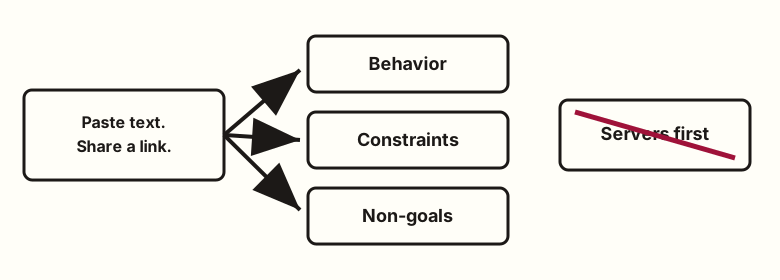
Design a pastebin. People paste text and share a link.
The interviewer will not add constraints unless you ask or assume them. Assumptions you state out loud are requirements. Assumptions you hide are land mines.
Attempt before reading
12 minutes. Do not scroll. Write four lists:
- Clarifying questions, at most six. Star the ones whose answer would change the data model, not just the UI.
- Functional behavior you are locking if they say “you decide.”
- Numbers you are assuming, with units. You will not be graded today on arithmetic. You will be graded on whether the number is an assumption or a wish. Derivation is day 3; do not look ahead.
- Non-goals. At least five. Each one is a product you are refusing to design in this hour.
If your functional list contains “scalable,” “fast,” or “secure” with no user-visible meaning, rewrite those three words before you read on.
Stop. Everything below is the worked requirements for the Week 1 pastebin.
Requirements
What you ask before you assume
Ask these. If the interviewer says “up to you,” lock the answer in the same breath and move on. Do not ask questions you are not willing to answer yourself.
| Ask | Lock if they shrug | Why it changes the design |
|---|---|---|
| Text only, or files and images? | UTF-8 text only. | Files are an object-storage problem with a different size curve. |
| Who can read a paste? | Anyone with the link. No public directory. | A directory is a feed. A link is a primary-key read. |
| Do links last forever? | No. The creator picks from an allow-list. | Retention dominates storage. “Forever” makes the storage answer unbounded. |
| Accounts? | No. Anonymous create. | Accounts add a login dependency on the write path. |
| Can the creator delete? | Yes, with a secret returned once at create time. | Otherwise a leaked URL is permanent until expiry. |
| Can they edit or replace? | No. | Edit is version history and cache invalidation. A new paste is a new id. |
| Custom or vanity URLs? | No. The service mints the id. | Vanity slugs are squatting, hot keys, and a second lookup table. |
What staff sounds like here: you ask fewer questions than you have, and you answer most of them yourself. “I’ll assume text only, anonymous, links that expire from a fixed list. Stop me if any of that is wrong.” That is three locks and one cheap veto in eight seconds. Six questions read out in a row hand the steering wheel to the interviewer and burn minute four waiting for answers they expected you to propose. Ask out loud only the questions whose answer would change the key, the retention, or who can read. Lock the rest in the same breath.
Two more you should raise even if they do not, because they are how pastebins embarrass people:
- The body is untrusted. You will not serve it as HTML. A paste that contains a script is text, not a page on your origin.
- Expiry is checked on the read path. A background sweeper is garbage collection, not correctness. A sweeper that is behind must not resurrect a paste that should be gone, and it must not be why a paste stays readable.
Functional behavior
- Create. Client sends a UTF-8 body and a TTL from the allow-list. Service returns an id, a URL, the expiry time, and a delete token. The token is shown once.
- Read. Client sends the id. If the paste exists and
now < expires_at, the body comes back astext/plainwithX-Content-Type-Options: nosniff. If it does not exist, or it exists but is expired, the response is the same not-found. You do not tell strangers which of those two it was. - Delete. Client sends the id and the delete token. Success removes the paste. A wrong token and an unknown id look the same from the outside.
- Syntax hint. Optional short label (“python”, “sql”), stored and returned as a header. The service does not highlight, render, or execute anything.
- Expiry allow-list. 1 day, 7 days, 30 days, 365 days. Default 30 days. The client sends a duration, not an absolute timestamp. The server clock computes
expires_at. You do not accept an arbitrary duration, because your storage assumption depends on this list.
Create is acknowledged only after the body and the metadata are durable. That is a requirement. The mechanism is day 5. Do not “solve” it with a product name today.
Failure the user sees, as a requirement
Most candidates wait until the design to say what failure looks like. By then the status codes are already improvised. Lock three sentences here, because each one decides what a 404 means and what the pager will watch.
- Create fails before the ack. The creator gets an error, not a link. They may retry, and a retry is a new paste. There is no “my pastes” page to recover a lost link from. That is the price of the no-accounts lock, said as a user-visible cost, not discovered later.
- Storage is sick while a paste is live. The reader gets a 5xx, never a 404. A 404 is a promise that the paste is gone on purpose. A system that “degrades gracefully” by returning 404 has turned data loss into something that looks like a normal miss, and nobody gets paged.
- The sweeper is behind. The reader still gets the 404 at
expires_at. Late garbage collection costs disk. It never costs correctness.
Those three are requirements, not mechanisms. Day 5 decides how to keep them. Today you decide that they are the contract, so that no later box is allowed to break them quietly.
Constraints you state as assumptions
These are the locks day 3 will turn into arithmetic. State them as assumptions, not as facts you measured.
| Assumption | Value | If the interviewer overrides you |
|---|---|---|
| New pastes | 10 million per day | Recompute. Do not scale every tier by vibes. |
| Reads per write | 50 | Links are shared. If they say 1:1, the product is a private notepad and egress stops being the story. |
| Mean body | 10,000 bytes | This is the sensitive one. Instrument it first in a real system. |
| Peak vs average | 3× | Diurnal peak, not a ticket drop. Do not stack a second hidden safety factor on top. |
| Effective retention | 45 days of ingest resident | Mix of the allow-list, weighted toward the default. Worst case on the list is everyone picking 365 days. |
| Max body | 1,000,000 bytes | Reject oversize. Do not truncate. |
| Regions | One | Multi-region is a non-goal this hour. |
| Id | Service-minted, unguessable, never reused | Width is a data-model question for day 4, because expired ids must not be recycled into a new paste. |
Units: 1 KB means 1,000 bytes in this course, and 1 GB means 10^9 bytes. Say that once so nobody “corrects” you with 1024 and thinks the design changed.
Know which locks you concede and which you defend. Numbers are knobs: if they say 100 million pastes a day, say “fine, I’ll redo the math with that” and move on. Do not argue for your own guess. Shape locks are not knobs: the TTL allow-list, never reusing ids, and the same 404 for expired and missing each change the data model. If they push on one of those, ask what product they want, because they are describing a different one. Conceding a number shows you can listen. Conceding a shape lock without saying what it costs is how a design quietly falls apart by minute twenty.
Latency, said as a budget rather than a dream: a read of a hot paste should be a primary-key lookup plus a short byte read, tens of milliseconds of server time in-region, not a global 100 ms promise. A create is bounded by durability, not by the network. You will put a number on that when you know the fsync story. “Low latency” is not a requirement.
Availability: one region is acceptable. You are not promising 99.99% today. You are promising that a lost disk is a stated failure, not a surprise. Day 5 owns that sentence.
Non-goals
Say these before you draw. Each one is a different interview you just declined.
- Accounts, profiles, “my pastes.”
- A public index, trending page, or search.
- Edit, replace, version history, or comments.
- Vanity slugs and custom domains.
- Binary uploads, images, and attachments.
- Syntax highlighting, execution, or a malware-scanning pipeline. (Abuse control is a follow-up, not a subsystem you design today. You will name where it would sit: on create, before the durable write.)
- End-to-end encryption beyond TLS. Disk encryption is an operational default, not a box.
- Forever retention.
- Multi-region active-active.
- Rendering a website on the paste URL. The paste URL returns text. If a UI exists, it is a different origin that inserts the body as text, not as HTML.
- A cache, a queue, a CDN, or a second service. Those are designs. They are not requirements. They have to earn a place from a number on day 3 or a fault on day 5.
Privacy in one line: the URL is the capability. You do not add a public ACL model. Anyone who has the URL can read until expiry or deletion. Say that so “private paste” does not sneak in as a second visibility flag you then have to enforce everywhere.
A non-goal is not “never.” It is “not in this hour, and here is what it would cost.” Give each likely push a one-clause cost:
- Accounts put a login dependency in front of create.
- Search needs a second index over untrusted text.
- Multi-region needs an authoritative copy on delete.
Under pressure, concede abuse limiting first: it sits in front of create and does not change the row. The one never to give up quietly is “private paste,” because it needs an identity, which you refused.
Design
There is no topology today. The design move is the lock itself.
The product you are designing is a capability-URL blob with a deadline. Create mints an unguessable id. Read is a point lookup. Delete is the same lookup plus a secret. Retention is an allow-list so storage stays bounded. The body is opaque UTF-8 bytes, served as plain text.
That sentence is enough design to start day 3. If you add a box, you should be able to point at the requirement it serves. “Scale” is not a requirement you have written down yet.
The requirement that will bite
Expired and missing must be indistinguishable to a reader. That single rule forbids a cute “this paste expired” page, and it forbids recycling ids. Recycling would hand a new writer’s content to anyone who still holds an old link. You will size the id space on day 4 against ids ever minted, not against rows currently alive.
The requirement that is not a cache
A hot link is still a point read of one id. Do not “solve” popularity in the requirements. Note it as a question for later: popularity changes load shape, not the contract.
Diagrams
Context and trust
flowchart LR
  creator[Anonymous creator]
  reader[Anyone with the link]
  pb[Pastebin]
  creator -->|text plus TTL| pb
  pb -->|url and delete token once| creator
  creator -.->|shares url out of band| reader
  reader -->|id| pb
  pb -->|text or the same not-found| reader
The trust boundary is the service. Clients are untrusted: bodies are hostile, clocks are wrong (which is why the client does not send expires_at), and the delete token is a bearer secret. There is no identity provider on the picture, on purpose. The link crosses a human channel you do not control. That channel is not your system, and you do not “secure” it with a microservice.
From a vague sentence to a lock
flowchart TD
  problem[Design a pastebin] --> ask[Questions that change the data model]
  ask --> lock[Behavior, bounds, assumptions]
  lock --> non[Non-goals said out loud]
  non --> stop[Stop. Do not draw yet.]
  stop --> later[Day 3 may use the numbers. Day 5 may draw.]
If your arrow from the problem points at “pick a database,” redo the diagram.
The picture ends at “Stop” on purpose. Every arrow before it is a decision you can be asked to defend. The arrow after it is where most candidates lose the requirements they just set, by drawing storage. If someone asks “so what would you store?” from this picture, the answer is the shape, not a vendor: one row keyed by an id, opaque bytes, a deadline.
Trade-offs
Choice. A capability URL, anonymous create, no accounts.
Alternative. Authenticated owners. Every paste has a user id. Read is open or private based on a flag. Delete uses the session.
What you give up. Lost URL means the creator’s only remaining power is the delete token, which they also have to keep. There is no “email me my pastes.” Support cannot verify ownership, because there is no owner. A token in a proxy log is a bearer secret; you will store only a hash (day 4), but the plaintext still exists on the client. Say who pays: the creator who lost the link. “No accounts” with no named victim sounds lazy; “a lost link is gone, and I accept that for a share-a-link product” is a decision.
Why you still choose it. The problem is “share a link,” not “build a user system.” Accounts put a login dependency in front of create, and they invite a private/public matrix you then have to get right on every read. The capability URL makes the read path one key.
10× break. Ten times the users does not flip this choice. Accounts at 10× are still a policy problem, not a scale win. What 10× will break is egress, metadata QPS, or backup, which you have not earned the right to name precisely until day 3. Do not “upgrade” to accounts because the system got bigger.
Second choice, shorter, because interviewers push it: no public listing. The alternative is a homepage of recent pastes. You give up discovery and “growth.” You avoid a fan-out or a ranking problem, abuse on a public wall, and a query that is not a primary key. At 10× a listing becomes its own product (a feed). It is still a non-goal. Popularity of a single link remains a point read.
Talking points
Say. “I’m treating the URL as a capability. No accounts, no directory, no edits. Expiry comes from a fixed allow-list, default 30 days, server clock. Expired and missing look the same. I will not render the body as HTML.”
Say. “My load assumptions are 10 million new pastes a day, 50 reads per write, 10 KB mean body, 3× peak, about 45 days of bytes resident. I have not done the arithmetic yet; I will, and these are the knobs if you disagree.”
Say. “Abuse limiting sits on create, before the durable write. I’m not designing the limiter unless you want that as the deep dive. The contract doesn’t require it for correctness of a single honest user.”
Hand-waving. “It should be secure.” Say instead: TLS, body served as text/plain, delete token stored hashed, ids unguessable and never reused, no HTML on the paste origin.
Hand-waving. “We’ll support private and public and unlisted.” You just created three authorization modes. Decline unless they insist, and if they insist, private means “we need accounts,” which you had as a non-goal. Make them choose.
Hand-waving. “Expire with a cron job.” A delayed job is not the read contract. The read checks expires_at. The job only reclaims space.
Say. “If storage is unhealthy while a paste is live, the reader gets a 5xx, not a 404. A 404 means gone on purpose. I want that line in the contract before I draw anything, so no later component is allowed to hide data loss as a miss.”
Hand-waving. “We’ll handle errors gracefully.” Graceful for whom? Name what the creator sees, what the reader sees, and which response code must never be used to cover a fault.
If they say “make it like Pastebin.com.” Take the behavior (text, link, expiry), not the ads, accounts, or syntax-highlighting farm. Say which parts you are copying and which you are leaving.
If they say “just assume whatever, let’s move on.” Give them four assumptions in one breath, with units, and write them in the corner: “Ten million a day, 50 reads per write, 10 KB, 45 days resident.” Moving on without them means the 10× question later has nothing to stand on.
If they override a lock at minute 15. Say which earlier sentence just changed and what it touches: “Private pastes means accounts, so create now has a login dependency and the read checks an owner. My key is unchanged; my read path grew a branch.” Then keep going. Do not quietly redraw everything.
Say this in the room
A pastebin, for this hour, is a capability URL with a deadline. Anonymous create, UTF-8 text only, no directory, no edit, no vanity ids. TTL comes from a fixed list, 1, 7, 30, or 365 days, default 30, set by the server clock. Expired and missing get the same 404, and a reader never gets a 404 when the system is the problem; that is a 5xx. Create returns a link only once the paste is durable, and a retry makes a second paste. My load assumptions are ten million pastes a day, 50 reads per write, 10 KB mean, 3× peak, about 45 days resident; those are knobs, change any of them and I will redo the math. The allow-list, never reusing ids, and the same 404 are not knobs, because they shape the data model. I am not designing accounts, search, rendering, multi-region, or abuse controls unless you want one of them as the deep dive.
Kit artifact
One checklist row. The rest of the requirements checklist belongs to the kit, sold separately. Practice this row now.
| Row | Lock |
|---|---|
| Non-goals for a pastebin hour | Accounts, listing, edit, vanity ids, forever-retention, HTML rendering, search, multi-region. |
If you cannot recite the row, you are not done with day 2. The kit is not required to recite it.
Design log
From your pre-read page: which non-goal did you miss, and which assumption did you state as a fact? One gap, one sentence.